
'Significantly, Foreign Secretary Gokhale was received at very high level in Beijing.' 'It only shows China's keenness to move forward and put the relationship on a 'win-win' footing,' says Ambassador M K Bhadrakumar.

'Problems will keep recurring unless China vows to resolve all outstanding issues between the two sides,' says Sana Hashmi.
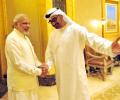
Apart from key bilateral issues, the two leaders also discussed situation in the region, particularly in wake of the increasing threat of terrorism and extremism from various sources including the Islamic State militant group.

'Look East' policy was first coined by the Narasimha Rao government in the 1990s and has been followed by the successive governments.

India and China on Friday agreed to seek a "political" solution to the border dispute at the earliest as Prime Minister Narendra Modi asked Beijing to "reconsider its approach on some issues" and announced CBMs like e-visa for Chinese tourists and operationalisation of hotline between two militaries.

'It is a pattern of behaviour of the Chinese that whenever a Chinese leader visits India or an Indian leader visits China, some incidents take place.' 'When Modi visits China, we should look out for some similar demonstration by the Chinese.'

'While China expressed reservations on the Indian role in the South China Sea, Beijing threw to the winds Indian concerns on Kashmir by announcing $46 billion in investments Pakistan occupied Kashmir,' says Srikanth Kondapalli.

Former Defence Minister A K Antony on Wednesday acknowledged "corruption" in the AgustaWestland chopper deal.

Before the 2014 Lok Sabha elections, Modi had criticised Manmohan Singh's policy towards China and promised a more strong-willed policy. Those claims are now under a cloud.

'If, as appears to be the case, India is on way to 'mending fences' with China, and China is equally desirous to 'reset' the relationship, this could be a self-reflexive moment in India's positioning vis-a-vis not just the Dalai Lama, but also the Tibetan issue and China as a whole,' points out China expert Alka Acharya.

Prime Minister Narendra Modi on Sunday discovered a "special connection" with Mongolia when he entered the Buddhist country's Parliament to deliver a speech, the first foreign leader to do so on Sunday -- a holiday.

Abbas seeks India's role in peace process as PM Modi visits Palestine.

After visiting two Central Asian countries, Prime Minister Narendra Modi arrived in Ufa on Wednesday on a three-day trip during which he will attend the BRICS and Shanghai Cooperation Organisation summits.
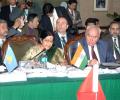
'The truly amazing part is the influence that Washington wields over Modi and the Sangh Parivar,' says M K Bhadrakumar. 'What explains it? The Americans know precisely well which raw nerve to touch and how to make the Sangh Parivar, Modi and this government perform the trapeze act.'

Pak seeks US help to ease tensions with India.

'How can a State, which claims to be a responsible power, unilaterally grab a "disputed" area to build a road on it?' asks Claude Arpi.

'We have petitioned the district collector and MEA to put pressure on the Saudis for compensation, but nothing has happened.' A Ganesh Nadar reports on the family's plight.

BJP general secretary Ram Madhav said the two neighbours needed to inject informality in their relations, as is the case in many places of the world like the EU and ASEAN.
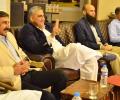
'Over the last year, Bajwa has created the environment to support bold moves on India. The ball is in India's court,' a senior Pakistan military officer tells Ajai Shukla.
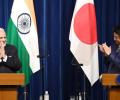
'Relations between India and Japan are robust and devoid of either shadow of history or any irritant.' 'In fact, there is plenty of warmth and goodwill earned over history. There are no negatives but only opportunities,' notes Dr Rajaram Panda.
'We don't want confrontation; we are trying to build a cooperative relationship in which both sides have stakes in producing an improving climate of relations and responsible behaviour.' What does Shiv Shankar Menon, one of India's most brilliant diplomats and the former National Security Advisor, think of the Modi visit to the US, the Chinese stand-off in Ladakh and the situation on the LoC?

Prime Minister Narendra Modi will leave for the Belgian capital as part of a three-nation tour during which he will attend the Nuclear Security Summit in Washington and visit.

'The only quality required in this tenure is to be the military's yes man and that he has the capacity to do so.'

'Both Modi and Xi know that if all that there is to show for Modi's visit -- barely eight months after Xi's India trip -- is a repeat of the same old declarations, there will be a terrible sense of letdown in the public mood resulting in future summits losing credibility. Only the possibility of new ground being broken can justify Modi's trip at this time,' says B S Raghavan.

India and Japan on Monday agreed to enhance their defence and strategic cooperation to a new level during talks between Prime Minister Narendra Modi and his counterpart Shinzo Abe, who also decided to speed up negotiations on civil nuclear deal that could not be concluded now.

The loan will be utilised in several developmental projects that Nepal wants to undertake. Nayanima Basu reports.

'An ardent advocate of nuclear disarmament, Obama may even be secretly heaving a sigh of relief that the NSG is unlikely to reach unanimity of opinion on India's candidature,' says Ambassador M K Bhadrakumar.
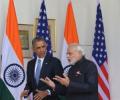
It is for the companies and the industry to ascertain where they want to run with the US-India civilian nuclear agreements reached by Washington and New Delhi, says United States Assistant Secretary of State Nisha Biswal. Aziz Haniffa reports for Rediff.com from Washington, DC
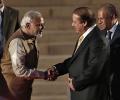
Prime Minister Narendra Modi has brought Hindi into vogue in the external affairs ministry and managed a diplomatic coup by inviting SAARC leaders, including Nawaz Sharif, to New Delhi for his swearing-in. Sheela Bhatt's impressions of the Indian prime minister's first day in office.
From France to Canada, from Japan to South Korea, all of Modi's barbs came in front of an NRI audience. Over the last one year, with 19 foreign visits, Modi has tried to use diplomacy as a PR event and foreign policy as a means to shore up his image back at home, says Shehzad Poonawalla.

Prime Minister Narendra Modi said India and the United Kingdom are economically made for each other.

'Foreign policy-making cannot be shifted out of Delhi and the regional satraps, who do not have a national perspective, should not be allowed to dominate foreign policy. But regional inputs should be integral to foreign policy-making at every step of the way,' says Ambassador T P Sreenivasan.

Prime Minister Narendra Modi on Sunday thanked France and wrapped up his first visit to Paris that saw the two nations elevate their strategic ties to a new level as they agreed on a deal for 36 Rafale fighter jets and decided to move ahead with the log-jammed Jaitapur nuclear project.

Narendra Modi's promise to allow states a bigger say in strategising and building foreign policy is unexceptionable, says TP Sreenivasan.

'Those who follow the workings of the establishment believe that Indian diplomacy has managed more by the individual flair and brilliance of a few individuals than its systemic strength or organisational excellence.'
'This is a US-India effort and it is not necessarily to counterweight anyone.'

India has no compelling reason to grant his request for asylum but was unduly inhibited in raising its voice against the United States' extensive and vulgar intrusion into the privacy of its institutions and citizens, says Shyam Saran

As the context of Panchsheel has changed, it is all the more essential that India and China need to reinvent and redefine Panchsheel for a new world order taking into account globalisation, and mutual economic interdependence. The new Panchsheel, in order to be relevant, needs to shed its binary approach of west verses the east recognising the seamlessness of global frontiers, which globalisation has brought in, says Rup Narayan Das.
'Today the Chinese think they can slap India, and there will be no consequences.' 'They must be made to feel the consequences through any and all means,' says Rajeev Srinivasan.
'When George Bush Senior decided in 1992 that India and the United States must start talking in this-now-changed world, who would have thought that 10, 15 years down the road, we will start looking at each other as strategic partners?'
